

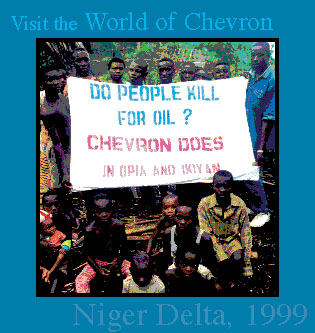
Visit the World of Chevron: Niger Delta, 1999
YOU KNOW THE QUESTION
 At a rate of over 400,000 barrels per year, Chevron is extracting oil from Nigeria. It does so today, as it has for decades, by hiding behind the threat and use of force by a military with a long record of terror against civilians. From its purchase of drilling rights in Nigeria from a British government of conquest and colonization, to its partnership with military dictators, to calling in soldiers during nonviolent protests, Chevron’s business strategy has been clear. Chevron tries to maximize profit through operations that undermine the health of local communities and ecosystems and by ignoring calls from increasingly impoverished communities to share the wealth taken from their land. Then, when criticized, it stands behind the military rather than subject itself to the will of the community.
In the 1990s, as organized protest, mass discontent, and resistance movements have emerged and grown in the oil-rich Delta region of Nigeria, the choice between listening to communities and supporting the guns that silence them has grown clearer. The nonviolent campaign of the Movement for the Survival of the Ogoni People (MOSOP), led by Ken Saro-Wiwa, forced oil giant Shell from the Ogoni homeland. The Nigerian government crackdown that followed, including the military occupation of Ogoni, deadly raids on Ogoni villages, detention of dozens of political prisoners, and the execution of Saro-Wiwa and eight others, thrust the issue onto the world stage. Inspired by MOSOP’s nonviolent direct action campaign, communities and peoples across the region have organized themselves to challenge the multinational oil companies, including Shell, Mobil and Chevron.
Groups such as the Ijaw Youth Congress, Niger Delta Women for Justice, and the pan-Delta nonviolent resistance group Chicoco (named after the word for the Delta’s rich soil) have built a strong grassroots base for resistance, and engaged in demonstrations, festivals, and peaceful occupations to further their demands.
“We have just taken a decision to extinguish the fierce flames of hell called gas flares on our land. We have done so because of its negative impact on our people, on our environment. The noise, the soot and the heat. The permanent daylight and the deaths of animals and plants. These sorrowful matters are far removed from Aso Rock (Nigeria’s Seat of Power), Kaduna, Ikoyi, Victoria Island, London, the Hague and San Francisco where the directors and shareholders of the companies live. Our people are on the receiving end of ecological violence. By this our symbolic gesture we hope the Nigerian state and the oil transnationals will appreciate that the issues go beyond price per barrel and that it is about life on planet Earth. The Ijaws and all other nations in the Niger Delta deserve a protected biosphere.”
— Oronto Douglas
Environmental lawyer with Environmental Rights Action
Speaking at the announcement of Operation Climate Change:
A program of demonstrations, dances, prayers and civil disobedience to end gas flaring in Ijawland
December 28, 1998
Do people really get killed so that oil companies can make a profit?
People do.
IS THE ANSWER A SURPRISE?
 In the past two years, Chevron has directly supported violent attacks on protesters and communities, while remaining silent during and after major terror operations which have been conducted by its partner, the Nigerian military, in areas near its operations.
May 1998: Parabe Offshore Platform Massacre
Over 100 Ilaje protesters conducted a nonviolent occupation of Chevron’s Parabe Offshore Platform protesting pollution of their land and water and demanding reparations for environmental damage and local employment. Chevron-operated helicopters transported in members of the Nigerian military, who began firing on the demonstrators. Jola Ogungbege and Aroleka Irowaninu died within minutes. Eleven youths who maintained the occupation were taken to jail where one, Bola Oyimbo, was interrogated, tortured, and unsuccessfully pressured to sign a false confession to piracy and property damage. While Chevron officials have admitted the protesters were unarmed, that it brought in the soldiers, and that its head of security was onboard, it denies that it bears responsibility for the deaths.
December 1998: Operation Climate Change Crackdown
Two warships and 10-15,000 Nigerian troops occupied Bayelsa and Delta states as the Ijaw Youth Congress (IYC) mobilized for Operation Climate Change, two weeks of nonviolent action to shut down gas flares in their homeland. Earlier, the IYC had issued demands for greater community power and the cessation of oil operations on December 30 in the Kaiama Declaration. Soldiers entering the Bayelsa state capital of Yenagoa announced they had come to attack the youths trying to stop the oil companies.
On the morning of December 30, two thousand young people processed through Yenagoa, dressed in black, singing and dancing. Soldiers opened fire with rifles, machine guns, and tear gas, killing at least three protesters and arresting twenty-five more. After a march demanding the release of those detained was turned back by soldiers, three more protesters were shot dead including Nwashuku Okeri and Ghadafi Ezeifile. The military declared a state of emergency throughout Bayelsa state, imposed a dusk-to-dawn curfew, and banned meetings. At military roadblocks, local residents were severely beaten or detained. At night, soldiers invaded private homes, terrorizing residents with beatings and women and girls with rape.
January 4, 1999: Opia and Ikiyan Villages Attacked
 Chevron transported about one hundred soldiers from the military base at Chevron’s Escravos facility aboard its leased speedboats and a helicopter to Opia and Ikiyan, two Ijaw communities in Delta State. Soldiers on board opened fire indiscriminately at each village. Bright Pablogba, the traditional leader of Ikiyan, who came to the river to negotiate with the soldiers, was shot along with a seven-year-old girl and possibly dozens of others. Of the approximately 1,000 people living in the two villages, four people were found dead and sixty-two were still missing months after the attack. The same soldiers set the villages ablaze, destroyed canoes and fishing equipment, killed livestock, and destroyed churches and religious shrines. On February 10, Chevron responded to a request from the communities by suggesting that both sides could meet at the officer’s mess of a local military base.
Chevron maintains its partnership with the government but “completely absolves itself from any responsibility” for these incidents. Its excuse is to say that it is only a junior partner in its Nigeria venture, with the government—a dictatorship for all but five of the last 34 years—owning 60%.
The World of Chevron
OIL DESTRUCTION IN THE DELTA
The Niger Delta is the second largest river delta in the world, spanning over 7700 square miles of fresh water swamp forests, lowland rainforests, mangroves, rivers and coastal barrier islands. It includes the largest wetlands and the largest mangrove forest in Africa, and is a site of extensive biodiversity with many endemic species. Despite its importance, no complete forest census or map of communities of the Delta has been assembled.
The infrastructure of the oil industry has been introduced into the midst of this region with no regard for local communities, local ecosystems, or the importance of specific places to those who live near them. The Chevron installation in Opia is typical: two wellheads and other equipment stand in an artificial inlet dug where “economic trees”—including palms, mangos, and coconuts—that were used by the community once stood. The three meter wide route cleared for a pipeline from the facility points straight through the village. Elsewhere pipelines criss-cross gardens and open terrain.
The extraction and transport of oil, a highly toxic substance, always poses serious threats to the surrounding environment. But Niger Delta communities, composed of indigenous peoples and minorities within Nigeria, face the additional challenges of military power, disrespect for minority rights within Nigeria, and racism on the part of Northern oil companies. The result has been a record of serious environmental damage compounded by the abuse of human rights.
Oil companies have indiscriminately dumped drilling muds, cuttings, and sludge throughout the Delta. Outdated, infrequently inspected, and inadequate oil pipelines have leaked extensively into the environment. Worst of all, massive quantities of gas that is found mixed in with oil underground is routinely ignited or flared off, rather than re-injected underground as required in the United States. This flaring pollutes the air and the rainwater, which is often the primary source of drinking and bathing water in communities on the coast. Consequently, the traditional bases of the Delta’s food system have been undermined: fish and wildlife is scarcer and potentially toxic, while crops such as cocoa, rice, and oil palms have diminished yields. What was once one of the most fertile parts of Africa is increasingly barren.
Less able to depend on their land, communities are increasingly dependent on the external market. Women’s traditional roles in fishing and farming have been disproportionately affected and they have had to move into the labor market where they are faced with sexist expectations and unfair wage scales. A small portion of the oil profits are allocated by the central government to the area but they have fueled a system of patronage and corruption. Expatriate oil workers contribute to social fabric breakdown, participating in prostitution and other forms of dependency, while very few locals are employed.
RESISTING CORPORATE RULE BY CHEVRON
The people of the Niger Delta have struggled for decades against the damage caused by the oil industry to their land, air and water. They have pressed their claims by appealing to the state, the oil companies, and to the courts, but the government has stood by the oil industry, compensation for damages has been inadequate, and the oil onslaught on the Delta has continued.
The Kaiama Declaration
We, the youths of Ijawland hereby make the following resolutions to be known as the Kaiama Declaration:
- All land and natural resources (including mineral resources) within the Ijaw territory belong to Ijaw communities and are the basis of our survival.
- We cease to recognise all undemocratic decrees that rob our peoples/communities of the right to ownership and control of our lives and resources, which were enacted without our participation and consent. These include the Land Use Decree and The Petroleum Decree etc.
- We demand the immediate withdrawal from Ijawland of all military forces of occupation and repression by the Nigerian State. Any oil company that employs the services of the armed forces of the Nigerian State to “protect” its operations will be viewed as an enemy of the Ijaw people. Family members of military personnel stationed in Ijawland should appeal to their people to leave the Ijaw area alone.
- Ijaw youths in all the communities in all Ijaw clans in the Niger Delta will take steps to implement these resolutions beginning from the 30th of December, 1998, as a step towards reclaiming the control of our lives. We, therefore, demand that all oil companies stop all exploration and exploitation activities in the Ijaw area. We are tired of gas flaring; oil spillages, blowouts and being labelled saboteurs and terrorists. It is a case of preparing the noose for our hanging. We reject this labelling. Hence, we advise all oil companies staff and contractors to withdraw from Ijaw territories by the 30th December, 1998 pending the resolution of the issue of resource ownership and control in the Ijaw area of the Niger Delta
- Ijaw youths and Peoples will promote the principle of peaceful coexistence between all Ijaw communities and with our immediate neighbours, despite the provocative and divisive actions of the Nigerian State, transnational oil companies and their contractors. We offer a hand of friendship and comradeship to our neighbors: the Itsekiri, Ilaje, Urhobo, Isoko, Edo, Ibibio, Ogoni, Ekpeye, Ikwerre etc. We affirm our commitment to joint struggle with the other ethnic nationalities in the Niger delta area for self-determination.
- We express our solidarity with all peoples organisations and ethnic nationalities in Nigeria and elsewhere who are struggling for self-determination and justice. In particular we note the struggle of the Oodua peoples Congress (OPC), the Movement for the Survival of Ogoni People (Mosop), Egi Women’s Movement etc.
- We extend our hand of solidarity to the Nigerian oil workers (NUPENG and PENGASSAN) and expect that they will see this struggle for freedom as a struggle for humanity
- We reject the present transition to civil rule programme of the Abubakar regime, as it is not preceded by restructuring of the Nigerian federation. The way forward is a Sovereign National Conference of equally represented ethnic nationalities to discuss the nature of a democratic federation of Nigerian ethic nationalities. [The All Ijaw Youths] Conference noted the violence and killings that characterized the last local government elections in most parts of the Niger Delta. Conference pointed out that these electoral conflicts are a manifestation of the undemocratic and unjust nature of the military transition programme. Conference affirmed therefore, that the military are incapable of enthroning true democracy in Nigeria.
- We call on all Ijaws to remain true to their Ijawness and to work for the total liberation of our people. You have no other true home but that which is in Ijawland.
- We agreed to remain within Nigeria but to demand and work for Self Government and resource control for the Ijaw people. Conference approved that the best way for Nigeria is a federation of ethnic nationalities. The federation should be run on the basis of equality and social justice.
Finally, Ijaw youths resolve to set up the Ijaw Youth Council (IYC) to coordinate the struggle of Ijaw peoples for self-determination and justice.
Resolved December 11, 1998 at the All Ijaw Youths Conference
Attended by over 5,000 youths and young adults at Kaiama in the Niger Delta
End Notes:
- Human Rights Watch, The Price of Oil, 1999, p. 53.
- Obasi Ogbonnaya, “In the Niger Delta, a ticking time bomb may be waiting to happen,” Guardian (Lagos), November 6, 1995, p. 9.
- Human Rights Watch, “Delta Crackdown,” May 1999.
- Chevron Nigeria Ltd. letter (signed A.O.Haastrup, Manager, Community Relations) to “Opia and Ikiyan Village Communities,” February 10, 1999.
- Chevron Nigeria Ltd. letter to “The Chairman, Elevenman Committee, Opia/Ikiyan Communities,” March 19, 1999. Quoted in Human Rights Watch, “Delta Crackdown,” May 1999. The quote refers to the Opia and Ikiyan attacks, but similar statements have been made about the other events listed here.
- Ijaw Youth Council, letter to “All Managing Directors and Chief Executives of transnational oil companies operating in Ijawland,” December 18, 1988; emphasis removed.